The History of the UK at the Eurovision Song Contest
The Eurovision Song Contest (or Eurovision) is an international singing and songwriting competition organised by the European Broadcasting Union. Featuring elaborate costumes and catchy songs, it’s one of the world’s most-watched events, with millions of people tuning in annually. The UK has been a participant since 1957, claiming victory five times along the way.
Learn more about this exciting event with our complete guide. We’ll share everything you need to know about the Eurovision Song Contest, including how the UK has helped shape the competition.
Heading to Liverpool for the 67th edition of Eurovision? Let us take care of accommodation with our conveniently located Leonardo Hotel Liverpool.
History of the Eurovision Song Contest
At its most basic level, Eurovision is a song contest where European countries (and confusingly, some non-European countries) battle it out to claim glory. It was originally created as an attempt to bring European countries together after the devastation of World War II. Here, we outline the competition’s history, from its origins to the present day.
The beginning
The first-ever Eurovision Song Contest took place in May 1956 in Lugano, Switzerland. Marcel Bezencon, the director of the European Broadcasting Union at the time, thought up the concept. Bezencon was keen to establish a television show similar to the Festival di Sanremo, Italy’s most famous pop music contest.
1956’s contest saw only seven countries participate: France, Italy, Belgium, Luxembourg, Switzerland, the Netherlands, and West Germany (as it was called then). The show was just under two hours and each country submitted two songs, with Switzerland taking the victory.
The ‘70s
The 1970s saw some of Eurovision’s most memorable participants win the contest, including ABBA, Milk and Honey, and Teach-In. In 1974, ABBA stole the show with ‘Waterloo’, securing Sweden’s first Eurovision win. This song became an international hit and the supergroup’s career flourished.
The ‘90s
After the Fall of the Berlin Wall in 1989, communism collapsed across Europe and newly sovereign nations turned up to perform on the Eurovision stage. In 1993, a relegation system was established, which stated that the seven lowest-scoring countries would not perform in the following year’s contest.
How has Eurovision evolved?
Since its inception, 52 countries have participated in the Eurovision Song Contest. Because of this, the competition’s format has evolved over the years. It now involves semi-final rounds before a select number of acts can perform in the final, with many eliminated along the way
During the first few contests, participants typically performed songs in their native language. However, as the event became more popular worldwide, songwriters began making their performances more universal to resonate with spectators. In 1973, a new rule was introduced that stated contestants could sing in any language they wanted to. This rule was scrapped in 1976 and re-introduced in 1999.
The competition is continually changing to meet the demands of its millions of viewers across the globe.
Who has won Eurovision the most?
Ireland is the most successful Eurovision participant, with seven wins. It’s followed closely by Sweden, with six wins, and Luxembourg, the Netherlands, the UK, and France – all with five wins.
To date, Ireland is the only country to have a performer win the competition more than once. Johnny Logan performed ‘What’s Another Year’ in 1980 and ‘Hold Me Now’ in 1987. It’s also the only country to have won three times in a row, in 1993, 1994 and 1995.
Why does Eurovision feature non-European countries?
Several Eurovision contestant countries are not members of the European Union, or even within the geographical continent of Europe. These include Australia, Egypt, Morocco and Lebanon. Eligibility for participation in the contest is not so much about location but more about European Broadcasting Union membership.
Eurovision and the UK
Our timeline highlights Eurovision UK winners and other important dates in the country’s Eurovision history.
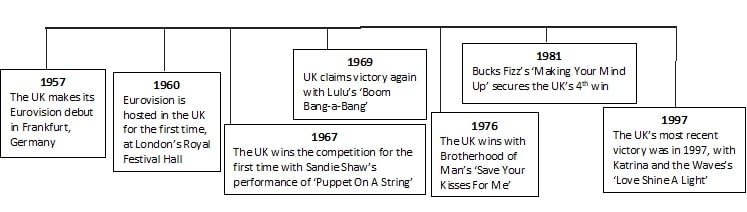
Although many residents have a love-hate relationship with the competition, the UK is one of Eurovision’s most passionate audiences. The country first participated in Eurovision’s second contest in 1957 and finished seventh among the 10 participating countries. In 1959, the country finished second for the first time, with Pearl Carr and Teddy Johnson’s performance of ‘Sing, Little Birdie’.
The ‘60s
During the 1960s, the contest became ever more popular with UK viewers as the BBC began choosing light-entertainment stars to perform. Notable acts included Cliff Richard and The Allisons, both of which finished in second place. In 1960, the UK hosted the Eurovision Song Contest for the first time at the Royal Festival Hall in London.
In 1967, 10 years after the UK made its Eurovision debut, it won the competition with Sandie Shaw’s ‘Puppet On A String’. This paved the way for the singer’s third international smash hit. In 1969, the UK won again in a four-way tie with Norway, Portugal, Sweden and Finland. This resulted in Portugal and Sweden withdrawing from the following competition as a sign of protest.
The ‘70s
During the 1970s, the UK’s influence as Eurovision winners continued to grow. The country claimed another victory in 1976 with Brotherhood of Man’s ‘Save Your Kisses For Me’. This song became a significant hit and sold six million copies worldwide, making it the most successful Eurovision-winning song ever at the time.
The ‘80s
The 1980s saw the UK become victorious for the fourth time with the iconic performance of ‘Making Your Mind Up’ by Bucks Fizz in 1981. The band were favourites to win. However, early votes for the UK were poor. Bucks Fizz won the competition by four points, with Germany taking second place. After the competition, ‘Making Your Mind Up’ became a number-one hit in the UK and eight other countries.
The ‘90s
The 1990s were full of disappointing results for the UK, with the country finishing low on the scoreboard on several occasions. However, Katrina and the Waves’ smash hit ‘Love Shine A Light’ meant we once again took the top spot in 1997. Katrina and the Waves were one of Eurovision’s most successful acts. Their song won by a whopping 70 points and became the band’s biggest UK hit.
With hosting duties generally handed to the previous years’ winner, the UK went on to hold the 1998 Eurovision at Birmingham’s National Indoor Arena. This was a particularly important year in Eurovision history. It was the first year televoting was used to determine the winner, and the last year a live orchestra was featured during the show.
The 21st century
The UK hasn’t received much Eurovision success during the 21st century but continues to be popular among viewers. So far, the country has not claimed victory and has finished last five times. However, there is a glimmer of hope for the nation, after Sam Ryder’s 2022 performance of ‘Space Man’ saw us take the runner-up spot. What could this year bring?
How many times has the UK won Eurovision?
The UK has claimed Eurovision victory a total of five times, in 1967, 1969, 1976, 1981 and 1997. It also holds the record of ranking runner-up most frequently, having claimed second place a whopping 16 times since 1957.
When was the last time the UK won Eurovision?
The last time the UK won the Eurovision Song Contest was in 1997, meaning it hasn’t yet secured a win in the 21st century.
UK Eurovision host cities
Since 1957, Eurovision has been held in several UK cities and towns.
|
UK location |
Venue and year |
|
London |
1960: Royal Festival Hall |
|
1963: BBC Television Centre |
|
|
1968: Royal Albert Hall |
|
|
1977: Wembley Conference Centre |
|
|
Edinburgh |
1972: Usher Hall |
|
Brighton |
1974: Brighton Dome |
|
Harrogate |
1982: Harrogate International Centre |
|
Birmingham |
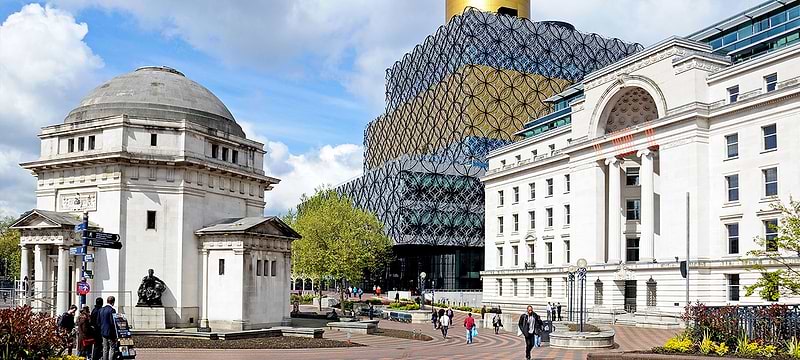
1998: National Indoor Arena |
In 2023, the UK will host the competition in Liverpool on behalf of Ukraine.
Eurovision fun facts
Below, we’ve rounded up six interesting Eurovision facts to help you learn more about the competition.
- Young winner—Eurovision’s youngest winner is Sandra Kim from Belgium. She was just 13 years old when she performed ‘J'Aime La Vie’ at the 1996 contest
- Competition rules—official Eurovision rules state that live animals cannot be brought on stage during a performance.As well as this, the competition only allows six members of a country’s delegation to be on stage for the performance.
- No success—some countries have not yet won the competition, including Malta, Cyprus and Iceland
- Eurovision curse—no country to perform second on the show has ever gone on to win
- A different name—the Eurovision Song Contest has not always gone by this name. The first few competitions were referred to as the Eurovision Song Contest Grand Prix
- Participation—Germany is the only country to have participated in Eurovision every year since 1956
2023 Eurovision
In 2023, the Eurovision grand final will take place on the 13th of May in Liverpool. It will be hosted at the Liverpool Arena in the city’s heart. The semi-finals will occur on the 9th and 11th of May.
Liverpool was successful in its bid to host the competition, thanks to its cultural offering and fan population, among other factors. Named the ‘City of Pop’, Liverpool has a reputation for hosting large-scale events, and the 67th Eurovision Song Contest will be added to the list later this year.
The European Broadcasting Union has released an official logo for this year’s competition, which features the Ukrainian flag. This serves as a reminder that although the contest will take place in Liverpool, it’s being held on behalf of 2022 winners Ukraine.
Liverpool is a city boasting great culture and history, with plenty to see and do. As the home of The Beatles, it has several music-based attractions, including the Cavern Club and the Beatles Statue. The city also houses some of the country’s best museums, where you can learn more about this vibrant location. Some of its best museums include the World Museum, the Maritime Museum and the Victoria Gallery & Museum.
Hotels in Liverpool for the Eurovision Song Contest
Need somewhere to stay during the Eurovision week? Our Leonardo hotel in Liverpool is a perfect choice, only a four-minute walk from Liverpool Arena. What’s more, it’s located close to some of the city’s best attractions, so you can fit in some sightseeing between the Eurovision shows. Royal Albert Dock is only a five-minute walk away, while the Museum of Liverpool is an 11-minute walk away.
Luxury is at the heart of our hotel. With spacious bedrooms and a stylish bar and restaurant, you’ll have everything you need for a pleasant stay. Guests also benefit from free Wi-Fi and an all-day Costa Coffee bar to grab a hot drink at their convenience. Whether you’re visiting as a family or with friends, our Liverpool hotel provides a fantastic base for Eurovision week.
Travelling by train? In that case, you’ll be pleased to know you can reach our Leonardo Liverpool hotel in 15 minutes by car from Liverpool Lime Street station.
Browse our Liverpool city guide for helpful travel inspiration, including what to see and where to shop.
Find your next hotel